5 Bird Feeders for Decks That Actually Work

Affiliate disclosure: Some links on this page are affiliate links. If you buy through them we earn a small commission at no extra cost to you. Recommendations are research-driven; we don't claim personal use of every product reviewed. Product prices and availability are accurate as of the date published and are subject to change. Always check Amazon for current pricing before purchasing. Learn more.
Quick Picks

Droll Yankees Yankee Flipper Squirrel-Proof Bird Feeder
Weight-activated motor spins the perch when a squirrel lands , reliably deters them
Buy on Amazon
Brome Squirrel Buster Plus Bird Feeder with Cardinal Ring
Passive weight-activated cage closes seed ports when squirrels grab on , no batteries needed
Buy on Amazon
Droll Yankees Classic Sunflower Seed Bird Feeder, 20-Inch
Ring Pull Advantage lid removes with one hand for fast, mess-free refilling
Buy on Amazon| Product | Price Range | Top Strength | Key Weakness | Buy |
|---|---|---|---|---|
| Droll Yankees Yankee Flipper Squirrel-Proof Bird Feeder best overall | $$ | Weight-activated motor spins the perch when a squirrel lands , reliably deters them | Requires charging , dead battery means squirrels have free access | Buy on Amazon |
| Brome Squirrel Buster Plus Bird Feeder with Cardinal Ring also consider | $$ | Passive weight-activated cage closes seed ports when squirrels grab on , no batteries needed | More involved cleaning than simple tray feeders | Buy on Amazon |
| Droll Yankees Classic Sunflower Seed Bird Feeder, 20-Inch also consider | $ | Ring Pull Advantage lid removes with one hand for fast, mess-free refilling | No squirrel deterrent , needs a baffle pole or dome purchased separately | Buy on Amazon |
| Nature's Hangout Window Bird Feeder with Strong Suction Cups and Seed Tray also consider | $ | Clear acrylic mounting brings birds within inches of indoor viewers , best close-up wildlife experience | Birds may take days or weeks to discover and trust a window-mounted feeder | Buy on Amazon |
| First Nature 3055 32-oz Hummingbird Feeder, Red also consider | $ | Wide-mouth base unscrews completely for easy cleaning , the biggest hummingbird feeder frustration solved | 32 oz capacity requires frequent cleaning in summer heat , nectar ferments in 3-5 days | Buy on Amazon |
Hanging a bird feeder off a deck railing sounds simple enough until you factor in squirrels dismantling it by noon, hummingbirds that want something completely different, a railing that may not support a pole mount, and a neighbor who apparently never has any of these problems. The range of feeders marketed for deck use is wide, and most of the buying guides online will tell you everything is great. This one won’t.
The five feeders below cover the main use cases: squirrel-proof with active deterrence, squirrel-proof without batteries, a clean budget tube feeder, a window-mount option for smaller spaces, and a dedicated hummingbird feeder. If you want a broader look at feeder types and how they compare, the Bird Feeders & Baths hub is a good place to start. For now, here’s what I’d actually put on a deck and why.
Top Picks for a Deck Bird Feeder
Droll Yankees Yankee Flipper Squirrel-Proof Bird Feeder
Droll Yankees Yankee Flipper Squirrel-Proof Bird Feeder
The Yankee Flipper works on a simple premise: a weight-activated motor spins the perch ring when something heavier than a songbird lands on it. A squirrel grabs on and gets gently rotated off. Then it tries again. Then it gets rotated off again. If you have children or grandchildren who spend time in the yard, this is the feeder they will want to watch.
The practical specs are solid independent of the entertainment value. The seed tube holds 5 lbs, which means fewer refills during heavy feeding periods in fall. The wide tube accepts sunflower or mixed seed without bridging. Recharging is via USB-C, and battery life is measured in months rather than days, so this isn’t a feeder you’ll be charging every week.
The honest concern is what happens when the battery dies and you don’t notice right away. The motor is the entire deterrent system. A dead battery gives squirrels unobstructed access, and they will find this out before you do. Set a calendar reminder when you charge it, or buy a second battery if this feeder is central to your setup.
Motor wear over time is a real consideration. Droll Yankees makes quality equipment and backs it with a guarantee, but any motorized component eventually logs enough hours to need replacement. For most buyers this is a years-out problem, not a months-out one.
Pros:
- Weight-activated motor reliably deters squirrels without cages or baffles
- 5 lb seed capacity reduces refill frequency
- USB-C recharging, battery lasts months per charge
- Good for families, high entertainment factor
Cons:
- Dead battery eliminates squirrel protection entirely
- Higher price than passive squirrel-proof options
- Motor will eventually wear
Best for: Anyone who wants active squirrel deterrence and doesn’t mind the occasional charging reminder.
,
Squirrel Buster Plus Bird Feeder with Cardinal Ring
Squirrel Buster Plus Bird Feeder with Cardinal Ring
The Brome Squirrel Buster Plus is the feeder I’d recommend to someone who doesn’t want to think about batteries, charging, or motors. The deterrent mechanism is passive: a spring-loaded outer cage drops down and closes the seed ports when weight above a set threshold lands on the perch ring. Squirrels are too heavy. Small songbirds aren’t. No moving parts beyond the spring, no power source required.
What makes this feeder genuinely more useful than most passive cage designs is the adjustable weight threshold. Out of the box, it’s calibrated to close against squirrel weight while allowing cardinals, chickadees, and finches. But if grackles are emptying your feeder in an afternoon (a specific problem if you’re in a region where they congregate in spring), you can tighten the threshold to exclude them. This is not common. Most weight-exclusion feeders give you one setting.
The cardinal ring is a wide perch addition that accommodates larger birds that can’t easily use a standard tube perch. Cardinals specifically are often excluded from tube feeders by port geometry, not just perch width. The ring addresses this without requiring a separate feeder.
Cleaning is more involved than a basic tray feeder. The cage disassembles, but there are more components than a tube-and-lid design. If you’re someone who cleans feeders thoroughly and regularly, budget a few extra minutes. If you’re someone who rinses feeders once a season, you’ll still manage, but it will take longer than you expect the first time.
Compared to the Yankee Flipper, the Squirrel Buster Plus costs less than half the price and requires nothing beyond refilling. The trade-off is that the Flipper is more visually entertaining and the Buster requires dialing in the weight sensitivity correctly, which takes a feeding session or two.
Pros:
- Passive deterrence, no batteries or charging required
- Adjustable weight threshold to exclude specific large birds
- 5.1 lb capacity, 6 feeding ports
- Cardinal ring accommodates larger species
Cons:
- Weight calibration requires trial and adjustment
- More parts to clean than simpler feeders
Best for: The practical default if squirrel deterrence is the priority and you don’t want to maintain a powered feeder.
,
Droll Yankees Classic Sunflower Seed Bird Feeder, 20-Inch
Droll Yankees Classic Sunflower Seed Bird Feeder, 20-Inch
The Classic is a straightforward tube feeder with no deterrent mechanism and no complexity. Six feeding stations, a UV-stabilized polycarbonate tube that won’t go cloudy or crack after a few seasons in direct sun, and Droll Yankees’ Ring Pull Advantage lid, which lifts off with one hand for refilling. That’s what you’re buying.
The 1 lb seed capacity is the main practical limitation. During fall migration or a hard winter with consistent bird traffic, 1 lb goes fast. If you have three or four feeders on a property, this one will need attention more often than the others. If it’s your only feeder, expect to refill every few days in heavy feeding periods.
The feeder has no squirrel deterrent built in. If your deck setup already handles squirrels via a baffle pole or overhead dome, this is a non-issue. If it doesn’t, squirrels will empty it. I’d pair this with either a bird feeder baffle for squirrels mounted below, or a squirrel dome overhead before putting it out on a deck with any squirrel pressure at all.
Droll Yankees makes its equipment in the U.S. and backs this feeder with a lifetime guarantee. that guarantee is worth more than it would be on a cheap import. This is a buy-once-and-replace-if-needed product rather than a buy-and-replace-when-it-deteriorates one.
Pros:
- One-handed Ring Pull lid, fast and clean to refill
- UV-stabilized tube, won’t fade or crack over time
- Six feeding stations
- Lifetime guarantee, American made
Cons:
- 1 lb capacity, frequent refilling required at peak seasons
- No squirrel deterrent, needs baffle or dome added separately
Best for: A clean, reliable budget entry point if squirrel deterrence is handled separately or isn’t a factor in your setup.
,
Nature’s Hangout Window Bird Feeder with Strong Suction Cups and Seed Tray
Nature’s Hangout Window Bird Feeder with Strong Suction Cups and Seed Tray
This feeder attaches to a window with suction cups and puts birds within arm’s reach of the glass. The suction cups are tested to hold for 12 months without repositioning, and in practice with similar mounts, the failure point is usually installation rather than the cups themselves. Clean the glass thoroughly before mounting, press firmly, and flip the locking tabs completely.
The appeal here is not capacity or squirrel-proofing. It’s proximity. A chickadee landing on a window-mounted feeder is a different experience than one visiting a pole feeder 10 feet away, and for households with children or elderly family members who can’t easily get outdoors, that proximity matters. If you want more detail on how window mounts compare on suction performance and seed tray design, the suction cup window bird feeder guide covers it.
The wait time is the patience test. Birds that have been feeding from established pole feeders will not automatically migrate to a new window mount. Days to weeks is a reasonable expectation, not a sign something is wrong with the feeder. Putting the window mount near an existing established feeder shortens the discovery window.
Cleaning requires removing the feeder from the glass, which is more involved than rotating a tube feeder open. It’s not difficult, but it’s a step that some buyers skip longer than they should.
For anyone with a small outdoor space, a balcony, or no room for a pole-mounted system, this is the practical answer. It’s not trying to compete with a 5 lb tube feeder on capacity. It’s trying to get birds six inches from your face, which it does.
Pros:
- Close-up viewing, birds within inches of the glass
- 4+ cup capacity handles multiple species
- Suction cups rated for 12+ months without repositioning
- Works where pole mounting is not an option
Cons:
- Birds may take days to weeks to discover a new window-mount location
- Cleaning requires removing from glass
Best for: Smaller outdoor spaces, balconies, or anywhere the close-viewing experience is the main priority.
,
First Nature 3055 32-oz Hummingbird Feeder, Red
First Nature 3055 32-oz Hummingbird Feeder
The First Nature 3055 is the hummingbird feeder I’d hand to someone buying their first one, because it solves the problem that causes most people to give up on hummingbird feeding: cleaning. The wide-mouth base unscrews completely, with no narrow necks or internal crevices that require a bottle brush and significant patience. This sounds like a small thing until you’ve spent fifteen minutes trying to clean a glass feeder with a one-inch opening in July heat. (I have. Twice. Before switching.)
At 32 oz and 10 feeding ports, the 3055 handles multiple hummingbirds simultaneously during peak migration, which in the Northeast runs roughly mid-August through September. The red coloring is sufficient to attract hummingbirds without adding red dye to the nectar, which is not necessary and may not be beneficial. Plain 4:1 water-to-white-sugar nectar, changed every three to five days in summer heat, is all this feeder needs to run.
The plastic construction is the honest trade-off. It’s functional, holds up to regular cleaning without clouding, and at this price it would be replaced rather than repaired anyway. If the aesthetic of a glass feeder matters to you, there are prettier options at two or three times the price. If what matters is keeping nectar fresh and hummingbirds coming back, function wins and the 3055 is the answer.
Pros:
- Wide-mouth base removes completely for easy cleaning
- 10 feeding ports, handles migration-period traffic
- Red color attracts hummingbirds without dyed nectar
- Strong value at the price point
Cons:
- Nectar requires changing every 3-5 days in summer heat
- Plastic, not as visually appealing as glass feeders
Best for: First-time hummingbird feeders or anyone who’s abandoned a glass feeder because cleaning was too tedious.
,
Buying Guide: Choosing a Bird Feeder for Your Deck
Match the feeder to the actual constraint
The most common mistake in feeder buying is optimizing for the wrong variable. If squirrels are emptying your feeder every morning, the seed capacity and feeding port count are irrelevant. Sort the squirrel problem first, either with an active deterrent like the Yankee Flipper, a passive cage mechanism like the Squirrel Buster Plus, or a baffle system paired with a simpler feeder.
If squirrels are not a problem on your deck (elevated decks with no nearby trees or overhanging structures genuinely do reduce squirrel access), you can ignore the deterrent premium and buy for capacity, species preference, and ease of cleaning.
Capacity vs. maintenance frequency
A 5 lb feeder requires less attention than a 1 lb feeder, but also concentrates more seed in one location, which can mean more ground spillage and more feeder traffic in a concentrated area. On a small deck, a 1 lb feeder refilled more often may actually be more manageable than a 5 lb feeder that turns your railing into a high-traffic zone.
Hummingbirds are a separate category
No tube feeder will serve hummingbirds, and no nectar feeder will attract seed-eating songbirds. If you want both, plan for two feeders. The First Nature 3055 is light enough to hang from a simple shepherd’s hook bracket, which most deck railings can accommodate alongside a tube feeder.
Cleaning is the maintenance variable people underestimate
A feeder that’s difficult to clean gets cleaned less often. Old seed grows mold. Old nectar ferments and can harm birds. Easy cleaning is not a luxury feature. It’s the thing that determines whether your feeder actually functions safely over time. The Ring Pull lid on the Droll Yankees Classic, the disassembling base on the First Nature 3055, and the cage design on the Squirrel Buster Plus all exist because someone thought about cleaning frequency. Reward that.
Deck mounting options
Most deck feeders hang from a bracket, a shepherd’s hook mounted in a nearby ground socket, or an over-the-rail mount with a clamp. If your deck has a railing, an adjustable over-rail pole is the fastest setup. If you’re mounting to a post or joist, a screw-in hook rated for at least 10 lbs handles any of the feeders here. The window-mount option bypasses this entirely.
For more on accessories that affect feeder performance, the Bird Feeders & Baths section covers baffles, poles, and cleaning tools in more detail.
,
Frequently Asked Questions
What is the best bird feeder for a deck with squirrel problems?
The Squirrel Buster Plus is the most reliable passive option. No batteries, no charging, and the adjustable weight threshold gives you control over which larger birds you’re willing to allow. The Yankee Flipper works as well or better on active deterrence, but the battery dependency is a real consideration. If you want a simpler feeder and are willing to add hardware, a bird feeder baffle paired with the Droll Yankees Classic is a cheaper path to the same result.
How do I hang a bird feeder on a deck railing without drilling?
Over-the-rail clamp brackets mount to most standard deck railings without tools or permanent hardware. They hold shepherd’s hooks or direct hanger arms and support feeders up to 5 or 6 lbs without issue. The Nature’s Hangout window feeder is the alternative if railing mounting isn’t practical at all, attaching directly to glass with suction cups.
How often should I clean a bird feeder?
Seed feeders should be cleaned every one to two weeks during heavy use periods, more often in wet weather when seed can mold faster. Nectar feeders need the nectar changed every three to five days in summer and the feeder rinsed every time. This is the single variable that most affects whether birds keep returning and whether the feeder is actually safe for them. Fermented nectar and moldy seed are both harmful.
Will a bird feeder on my deck attract
Droll Yankees Yankee Flipper Squirrel-Proof Bird Feeder
- Weight-activated motor spins the perch when a squirrel lands , reliably deters them
- 5 lb seed capacity; wide seed tube fits sunflower and mixed seed
- Requires charging , dead battery means squirrels have free access
Squirrel Buster Plus Bird Feeder with Cardinal Ring
- Passive weight-activated cage closes seed ports when squirrels grab on , no batteries needed
- 5.1 lb capacity with 6 feeding ports; cardinal ring accommodates larger birds
- More involved cleaning than simple tray feeders
Droll Yankees Classic Sunflower Seed Bird Feeder, 20-Inch
- Ring Pull Advantage lid removes with one hand for fast, mess-free refilling
- Six feeding stations accommodate multiple bird species simultaneously
- No squirrel deterrent , needs a baffle pole or dome purchased separately
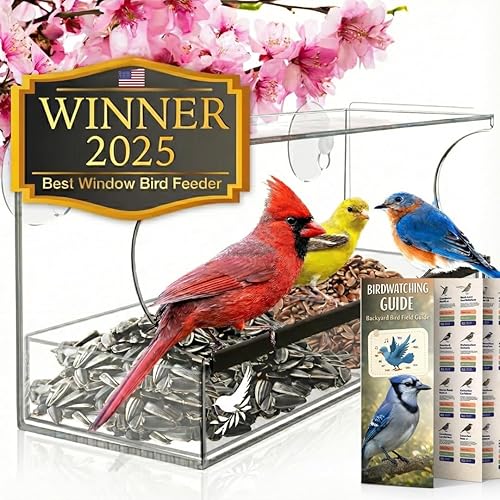
Nature's Hangout Window Bird Feeder with Strong Suction Cups and Seed Tray
- Clear acrylic mounting brings birds within inches of indoor viewers , best close-up wildlife experience
- Large capacity (4+ cups) handles multiple species simultaneously
- Birds may take days or weeks to discover and trust a window-mounted feeder
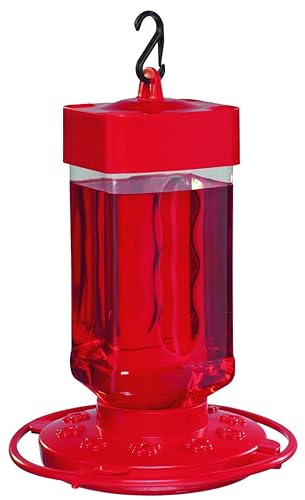
First Nature 3055 32-oz Hummingbird Feeder, Red
- Wide-mouth base unscrews completely for easy cleaning , the biggest hummingbird feeder frustration solved
- 10 feeding ports accommodate multiple hummingbirds simultaneously during peak migration
- 32 oz capacity requires frequent cleaning in summer heat , nectar ferments in 3-5 days
Frequently Asked Questions
What is the best squirrel-proof bird feeder for a deck?
The Droll Yankees Yankee Flipper is the most reliably squirrel-proof option — its weight-activated spinning perch physically removes squirrels before they can access seed. The Brome Squirrel Buster Plus is a strong passive alternative that uses a weighted cage to block seed ports without any battery or motor.
How do I hang a bird feeder from a deck railing without drilling?
Deck railing hook clamps (such as the IDZO two-pack) attach to the top of a railing with a set screw and extend outward, providing a hanging point for feeders and baths. They work on most standard railings up to about 3 inches thick and allow repositioning without damaging the deck.
What seed attracts the most birds to a deck feeder?
Black-oil sunflower seed attracts the widest variety of common feeder birds including chickadees, nuthatches, finches, cardinals, and sparrows. Avoid mixed seed blends with milo or millet filler, which many birds discard onto the deck. Nyjer (thistle) seed in a separate feeder targets goldfinches specifically.
Is the Droll Yankees Yankee Flipper worth the price for deck use?
For decks with serious squirrel pressure, yes — it's the feeder people buy after losing two or three cheaper ones. The motor is reliable and the battery life is long. The main risk is forgetting to recharge it, which leaves the feeder unprotected. At around $130–$170, it's a significant purchase but typically ends the squirrel problem definitively.
Can I attract hummingbirds to a deck feeder setup?
Yes, but hummingbirds require a completely separate nectar feeder — they won't use a seed feeder. The First Nature 3055 is a practical option with a wide-mouth base for easy cleaning, which matters because nectar ferments in 3–5 days in summer heat and a feeder that is difficult to clean will stop being cleaned regularly.
Where to Buy
Droll Yankees Yankee Flipper Squirrel-Proof Bird FeederSee Droll Yankees Yankee Flipper Squirrel… on Amazon