Deer Out Deer Repellent: 2 Methods That Actually Work

Affiliate disclosure: Some links on this page are affiliate links. If you buy through them we earn a small commission at no extra cost to you. Recommendations are research-driven; we don't claim personal use of every product reviewed. Product prices and availability are accurate as of the date published and are subject to change. Always check Amazon for current pricing before purchasing. Learn more.
Quick Picks

Liquid Fence Deer and Rabbit Yard Repellent Ready-To-Use, 1 Gallon
Ready-to-use formula , no mixing; trigger sprayer applies directly to plants
Buy on Amazon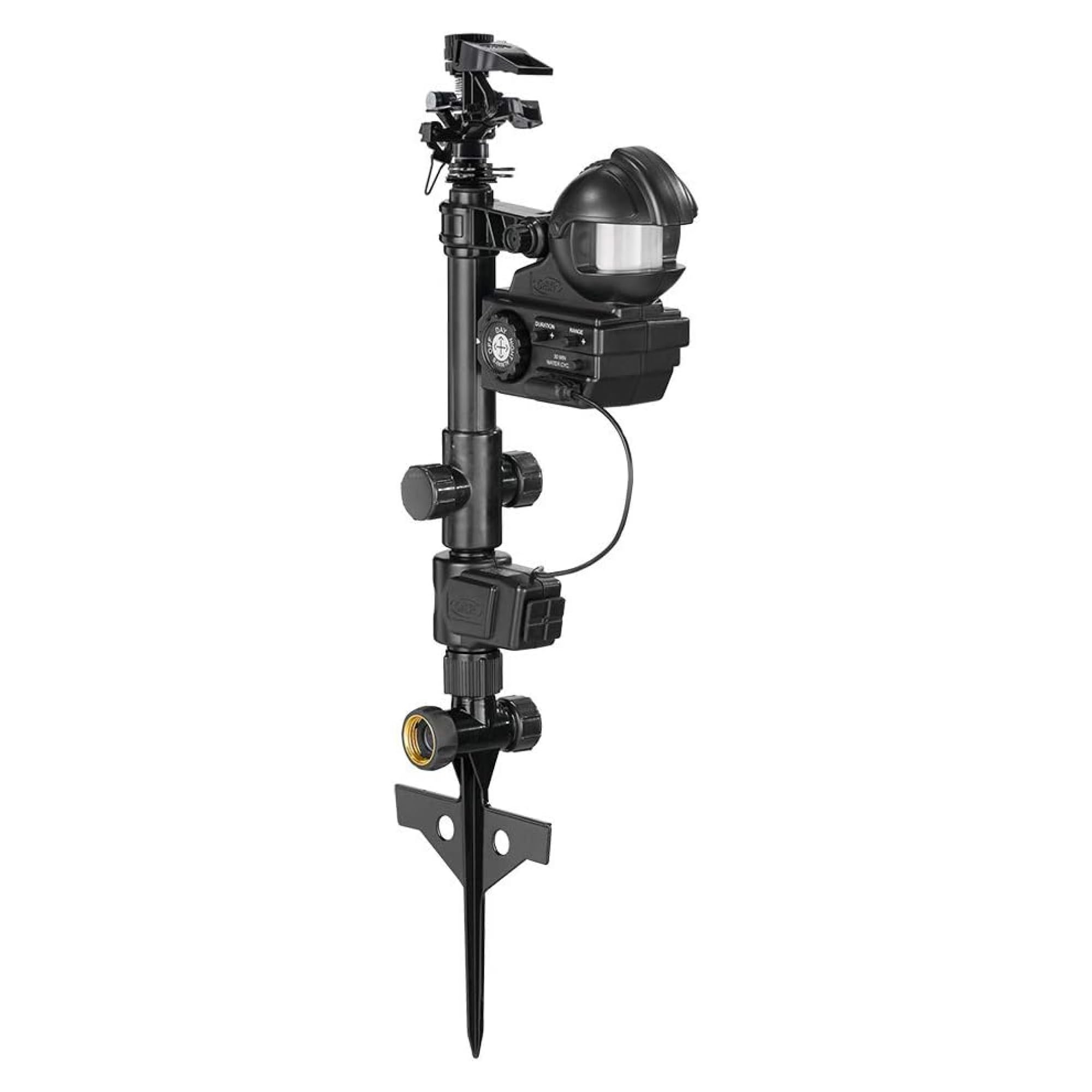
Orbit 62000 Yard Enforcer Motion-Activated Deer Repellent Sprinkler, 2-Pack
Deters deer, rabbits, cats, raccoons, and birds without chemicals or harm
Buy on Amazon| Product | Price Range | Top Strength | Key Weakness | Buy |
|---|---|---|---|---|
| Liquid Fence Deer and Rabbit Yard Repellent Ready-To-Use, 1 Gallon best overall | $ | Ready-to-use formula , no mixing; trigger sprayer applies directly to plants | Strong sulfur/egg odor during and shortly after application | Buy on Amazon |
| Orbit 62000 Yard Enforcer Motion-Activated Deer Repellent Sprinkler, 2-Pack also consider | $$ | Deters deer, rabbits, cats, raccoons, and birds without chemicals or harm | Can be triggered by other movement (blowing shrubs, passing people) , positioning matters | Buy on Amazon |
Deer pressure is not a casual problem. If you’ve walked out to find your hostas reduced to stubs or your vegetable beds stripped overnight, you know the specific frustration of having done everything right except account for a 150-pound animal that treats your garden as a salad bar. Finding a repellent that actually works, and that you’ll keep using consistently, is where most people get tripped up.
This guide covers the two approaches I’d actually recommend: a chemical repellent that applies fast and covers a lot of ground, and a motion-activated sprinkler that works without any spray at all. Both have a legitimate place in a layered deterrent setup. Neither is perfect on its own. I’ll tell you which one I’d reach for first, and under what circumstances I’d use both at once.
If you’re also dealing with squirrels raiding your feeders or trying to protect a bird bath setup, the broader Bird Feeders & Baths section has guides for those problems separately. Deer repellents sit in their own category, but the logic of layered deterrence applies across all of it.
What to Look For in a Deer Repellent
Repellency Mechanism
Deer repellents work through one of two mechanisms. Scent and taste deterrents (sprays, granules, egg-based formulas) train deer to associate your plants with something unpleasant. Physical deterrents (sprinklers, fencing, ultrasonic devices) interrupt the deer’s approach before it reaches the plant. Each has a different failure mode.
Scent-based repellents fail when rain washes them off or when the deer population is large enough and hungry enough to override the aversion. Physical deterrents fail when they’re badly positioned, run out of batteries, or are triggered so often by other movement that they stop deterring anything.
Coverage Area and Application Method
A gallon of ready-to-use liquid repellent covers a finite area. For a small kitchen garden or a set of ornamental beds near the house, that’s manageable. For a larger property with multiple exposure points, you’ll burn through ready-to-use formula fast and want to look at concentrate. The math matters: at roughly $18 to $22 per gallon of ready-to-use formula, covering 300 to 400 linear feet of plant material is straightforward. Covering a 12-acre perimeter is not.
Sprinkler deterrents cover a defined radius, typically around 40 feet at the widest, and protect one zone at a time. Multiple units are needed for multiple entry points.
Rain Resistance and Reapplication Frequency
Any spray repellent that claims it “never needs reapplication” is selling you something. Rain resistance is real and varies by formula, but nothing survives a genuine soaking indefinitely. Look for products that are honest about their 2-to-4-week window and plan your reapplication schedule accordingly. Late spring through early summer, when deer are moving with new fawns, is when skipping a reapplication cycle costs you the most.
Safety Around Pets, Children, and Desirable Wildlife
Egg- and sulfur-based repellents are non-toxic once dry. Motion-activated sprinklers are harmless to deer and everything else. If you’re also managing a yard with bird feeders, be cautious about granular repellents near feeding areas. The bird feeder pole with squirrel baffle setup I covered elsewhere shows how physical deterrents and scent-free solutions can coexist in a shared wildlife space.
Top Picks
Liquid Fence Deer and Rabbit Repellent Ready-To-Use, 1 Gallon
Best for: spray-and-forget coverage of defined ornamental and vegetable beds
Liquid Fence is the repellent I’ve come back to most consistently. The formula is egg- and garlic-based with a sulfur component, and it works through scent conditioning: deer smell it, associate the area with something off, and go elsewhere. It takes a few applications to establish that association, so the first two weeks are your training period, not your result period.
The gallon jug comes with a trigger sprayer attached. No mixing, no transfer to a separate sprayer, no leftover concentrate sitting in a pump bottle getting old. Apply it, cap it, done. At currently, it’s priced reasonably for what it delivers.
What actually works. Rain resistance is real. After moderate rainfall I haven’t needed to reapply until the two-week mark. After a genuine downpour, I reapply within a couple of days. The label says 2 to 4 weeks, and that’s an honest range, not marketing padding.
It handles deer and rabbits in one application, which matters if you’re protecting vegetable beds. I’ve had rabbit damage on lettuce that rivaled deer damage on hostas, and having one product address both reduces the complexity.
Once dry, it’s safe around dogs and kids, which I mention because I’ve had people ask after the smell and assume toxicity. The smell is the mechanism. It’s unpleasant while wet and for a short window after. (The first time I applied it near the house, my husband came out and asked what had died. It was a fair question.) By the next morning, humans can’t detect it. Deer apparently can, which is the point.
What to know going in. This is not a permanent solution. It requires reapplication, especially during heavy rain periods. If you miss a cycle during peak deer pressure in spring, you’ll see it in your plants.
For large properties, the ready-to-use gallon gets expensive. The concentrate version (available on Amazon under ASIN B014UUZ8AC) and makes significantly more product. If you’re covering more than a few garden beds, the math strongly favors the concentrate.
Verdict. This is where I’d start if you’re new to spray repellents, or if you want something you can deploy in an afternoon without any equipment. Reapplication is the discipline it requires. Build that habit and it holds up.
Orbit 62100 Yard Enforcer Motion-Activated Sprinkler
Best for: garden beds you want protected without repeated spray applications
The Yard Enforcer is a motion-activated sprinkler on a ground stake. Connect it to a hose, set the detection mode (day only, night only, or 24-hour), and it fires a short burst of water when the infrared sensor detects movement within its range. The detection arc is 120 degrees out to about 40 feet. For a standard rectangular garden bed, one unit covers the approach.
At currently, it’s a meaningful step up from a gallon of spray repellent. It’s also a fundamentally different product. You’re not conditioning deer through scent aversion. You’re startling them repeatedly at the entry point until they stop coming. The training effect is real: most users report a noticeable reduction in deer approach behavior within two to three weeks, after which the sprinkler fires less often because the deer have rerouted.
What actually works. Day/night detection mode control is more useful than it sounds. If you have foot traffic through your yard during the day, running the sprinkler in night-only mode prevents you from hosing your own kids or your neighbor’s dog. Flip it to 24-hour during peak pressure when you know deer are moving in daylight.
No chemicals. No smell. No reapplication schedule. If you’ve got a garden you’re also managing for birds, that matters. I’d pair this with a modern bird bath or a nearby feeder without concern, since the only deterrent here is a brief water pulse.
The deterrent doesn’t distinguish species, which is relevant. It will also fire at cats, raccoons, herons going after a pond, and the occasional squirrel. If you’re using a bird feeder for peanuts nearby, position the Yard Enforcer so the detection zone doesn’t include the feeder approach, or you’ll be making life very difficult for every jay in the area.
What to know going in. Positioning is everything with this unit. Pointed at a shrub that moves in the wind, it fires constantly and burns through batteries. The product gets around 7,500 activations per battery set (4 AA batteries). If it’s being triggered by wind all day, that number goes fast. Spend twenty minutes getting the placement right. Aim across an approach path, not at vegetation.
The hose connection is standard. In the spring and fall, the unit works well. Once you’re draining outdoor hoses for winter, the Yard Enforcer comes in. Something to plan around.
Verdict. For a dedicated garden bed with a clear deer entry path, this outperforms any spray over time because it doesn’t require reapplication and its effectiveness compounds as deer learn to avoid the zone. It costs more upfront and requires correct positioning. Both are manageable.
How to Choose Between Them
The spray repellent is lower cost, faster to deploy, and flexible. Cover multiple beds in different parts of the yard in an hour. The trade-off is the reapplication schedule and the odor window.
The motion sprinkler is a permanent fixture for the season, requires correct positioning, and works best when deer have a predictable approach route. The trade-off is cost per zone and losing the unit once the hose goes away for winter.
If I were protecting a small-to-medium kitchen garden and had one clear exposure point, I’d use both. Spray the plants directly and position the Enforcer across the approach. The spray addresses what the sprinkler misses (deer that come in from angles outside the detection zone), and the sprinkler addresses what spray alone can’t do (prevent deer from getting close enough to test whether the plants taste bad). That layered approach is not overkill on a property with serious deer pressure.
If budget is the constraint, start with Liquid Fence. It’s the lower-risk investment and it works. Add the Orbit Yard Enforcer once you’ve identified the specific entry point that needs more stopping power.
For anyone managing a broader yard setup with feeders, baths, and wildlife considerations, the full wildlife and feeder guides are worth a look before you finalize your layout.
Frequently Asked Questions
How often does Liquid Fence Deer Repellent need to be reapplied?
The label says every 2 to 4 weeks, and that’s accurate under normal conditions. After heavy rain, reapply sooner, within a day or two if the rainfall was significant. During peak deer pressure in late spring and early summer, err toward the 2-week end. The first two applications are most important: they establish the scent aversion. Missing the second application before deer have fully learned to avoid the area is where most failures happen.
Does the Orbit Yard Enforcer work at night?
Yes. Set it to night-only or 24-hour detection depending on your situation. Night-only is the more practical setting for most yards with daytime human or pet activity. The infrared sensor detects heat and motion, not light, so it’s equally effective after dark. Deer are most active at dawn and dusk, so 24-hour mode is worth using during periods of high pressure.
Will spray repellents wash off in the rain?
Liquid Fence is formulated to be rain resistant once dry, and it holds up reasonably well through moderate rainfall. A heavy, prolonged soaking will shorten the effective window, so reapplication is needed sooner after significant rain. There’s no spray repellent on the market that maintains full effectiveness indefinitely in wet conditions, regardless of what the label implies.
Can I use both a spray repellent and a motion-activated sprinkler together?
Yes, and I’d recommend it for serious deer pressure. The spray repellent conditions deer through scent aversion at the plant level. The motion sprinkler deters approach at the perimeter. Together, they address different points in the deer’s path to your plants. Position the Yard Enforcer across the approach route and spray plant material directly with Liquid Fence on the same reapplication schedule you’d use otherwise.
Is Liquid Fence safe to use around vegetable gardens?
Yes. The formula is egg- and garlic-based with sulfur components. It’s non-toxic to humans, pets, and wildlife once dry. Apply it to the foliage surrounding edible plants, and to the soil perimeter, rather than directly to edible portions you plan to harvest. The odor is strong during and shortly after application but dissipates to human perception within hours. Wash any produce from treated areas before eating, as you would with anything grown outdoors.
Frequently Asked Questions
What is the difference between Deer Out and other deer repellent sprays?
Deer Out uses a peppermint-oil base rather than the sulfur and putrescent egg compounds found in most competitors, which makes it significantly less offensive to humans while still providing deterrence. The tradeoff is that mint-based formulas may not trigger as strong a fear response in high-pressure deer populations.
How long does Deer Out deer repellent last after application?
Under normal outdoor conditions, expect 2–4 weeks of effectiveness before reapplication is needed. Rain, heavy dew, and new plant growth all reduce coverage, so inspect treated plants weekly during active growing season.
Can I use deer repellent on my vegetable garden without contaminating the harvest?
Some deer repellents are labeled safe for use on edibles with a specified pre-harvest interval — always check the product label before spraying on food crops. For vegetables, a motion-activated sprinkler is often a cleaner deterrent since it involves no chemicals at all.
Should I use both a spray repellent and a motion-activated sprinkler?
A layered approach works best under heavy deer pressure: spray repellents cover large areas and work passively, while a motion sprinkler adds a startle deterrent at key entry points. Using both together is more effective than relying on either method alone.
Why do deer become less deterred by repellent over time?
Deer can habituate to any single deterrent if food pressure is high enough and the threat never actually materializes. Rotating between repellent types or combining chemical and physical deterrents reduces the chance of habituation and keeps the deterrent effect stronger over the season.
Where to Buy
Liquid Fence Deer and Rabbit Yard Repellent Ready-To-Use, 1 GallonSee Liquid Fence Deer and Rabbit Yard Rep… on Amazon