Wall Mounted Patio Heaters: 7 Top Picks

Affiliate disclosure: Some links on this page are affiliate links. If you buy through them we earn a small commission at no extra cost to you. Recommendations are research-driven; we don't claim personal use of every product reviewed. Product prices and availability are accurate as of the date published and are subject to change. Always check Amazon for current pricing before purchasing. Learn more.
Quick Picks

Powerscale 1500W Electric Wall-Mounted Patio Heater
Wall-mounted saves floor space
Buy on Amazon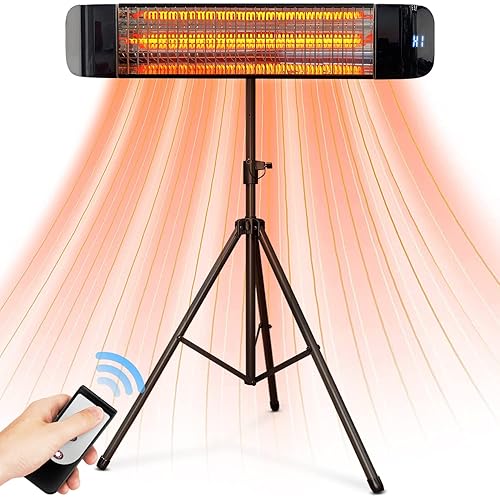
Paraheeter Electric Infrared Patio Heater
Wall-mounted saves floor space
Buy on Amazon
Generic WiFi Wall-Mounted Electric Outdoor Heater, 1500W
Wall-mounted saves floor space
Buy on Amazon| Product | Price Range | Top Strength | Key Weakness | Buy |
|---|---|---|---|---|
| Powerscale 1500W Electric Wall-Mounted Patio Heater best overall | $$ | Wall-mounted saves floor space | Requires wall mounting installation | Buy on Amazon |
| Paraheeter Electric Infrared Patio Heater also consider | $$ | Wall-mounted saves floor space | Requires wall mounting installation | Buy on Amazon |
| Generic WiFi Wall-Mounted Electric Outdoor Heater, 1500W also consider | $$ | Wall-mounted saves floor space | Requires wall mounting installation | Buy on Amazon |
| Generic 1500W Electric Infrared Wall/Ceiling Patio Heater also consider | $$ | Wall-mounted saves floor space | Requires wall mounting installation | Buy on Amazon |
| Generic 1500W Wall-Mounted Carbon Infrared Patio Heater with Remote also consider | $$ | Wall-mounted saves floor space | Requires wall mounting installation | Buy on Amazon |
If you’ve been heating your patio with a freestanding propane unit, you already know the problems: tanks to swap, floor space eaten up by a stand, and a heater that tips over if the wind catches it wrong. A wall mounted patio heater solves most of that. Fixed position, no floor footprint, and on an electric model, no fuel logistics at all. You flip a switch and the heat arrives in about 30 seconds.
The category has filled out considerably in the past few years, which means there are now plenty of options that look reasonable on a product page and disappoint in actual use. I’ve gone through the current mid-range electric field, all 1500W infrared units in the mid-range price band, and sorted out what’s actually worth buying from what’s padding the category. If you’re weighing patio heating more broadly, the Fire Pits & Patio Heaters hub covers the full range of options including propane and wood-burning alternatives.
Top Picks
Powerscale 1500W Electric Wall-Mounted Patio Heater
Best overall pick.
The Powerscale 1500W Electric Wall-Mounted Patio Heater, which puts it in the middle of this category. For that price, you get a clean, rectangular unit with a proper IP65 weatherproof rating, a remote control, and an adjustable mounting bracket that lets you tilt the head downward rather than pointing it straight out from the wall. That tilt adjustment is more useful than it sounds. If you mount this at 8 feet, you want the heat angled toward the people below it, not projecting horizontally into the yard.
The heating element is quartz infrared, which means it warms objects and people rather than the air around them. In practice, on a 40-degree evening with any amount of wind, you notice that distinction. Convective patio heaters lose most of their output the moment a breeze moves through. Infrared doesn’t.
At 1500W, you’re pulling about 12.5 amps on a standard 120V circuit. That’s within range of a dedicated outdoor outlet without additional electrical work for most setups, though you should confirm your circuit capacity before mounting.
Pros.
- Adjustable tilt bracket included
- IP65 weatherproof rating
- Remote control with three heat settings
- Clean, low-profile design
Cons.
- No timer function
- At 1500W, it’s a meaningful addition to your electric bill on a long evening
,

Paraheeter Electric Infrared Patio Heater
Best for covered porches.
The Paraheeter Electric Infrared Patio Heater. It’s been in the market longer than some of the newer entries here and has a larger review base to draw on, which I weight reasonably heavily when I’m evaluating generic-category products.
The Paraheeter is a ceiling or wall mount unit, and the hardware accommodates both configurations. If you have a pergola with crossbeams or a covered porch ceiling at 9 feet, ceiling mounting creates a more even heat distribution across a seating area than a wall unit angled from one side. The bracket is straightforward and the mounting process is about 20 minutes with a drill and a stud finder.
Heat output is consistent and the element warmup time is fast, under a minute to full output. The unit doesn’t have WiFi or app control, which is either a drawback or irrelevant depending on how you feel about putting your patio heater on a smart home network. I don’t need my heater on an app (which I realize is a specific preference and not a universal principle), but the option matters to some buyers.
Pros.
- Wall or ceiling mounting, hardware included for both
- Established product with meaningful review history
- Fast warmup time
- Quiet operation
Cons.
- No remote timer
- Controls are on the unit itself, which is inconvenient at ceiling height without the optional remote
,
WiFi Wall-Mounted Electric Outdoor Heater, 1500W
Best for smart home integration.
The WiFi Wall-Mounted Electric Outdoor Heater. The distinguishing feature is obvious from the name: app control via 2.4GHz WiFi, compatible with both Alexa and Google Home. If you’ve already built out a smart home setup and want your patio heater to power on when you unlock the back door, this is the only unit in this roundup that can do that.
The heater itself is a standard 1500W quartz infrared unit with a wall-mount bracket. The weatherproofing is rated IP55, one step below the Powerscale’s IP65. That difference matters in heavy rain or direct water exposure but is largely irrelevant under a porch overhang, which is where most wall-mounted heaters end up anyway.
Setup requires connecting the unit to a 2.4GHz network (5GHz is not supported, which is a common stumbling block worth knowing before you start). App connectivity is handled through a standard smart home controller app. I’d call the WiFi function useful rather than essential, but if automated scheduling matters to you, this is the unit to buy.

Pros.
- Alexa and Google Home compatible
- Built-in scheduling through app
- Remote and manual controls also included
- Solid construction
Cons.
- IP55 rather than IP65 weatherproofing
- 2.4GHz only, which can be a setup friction point
- Dependent on your WiFi for remote features
,
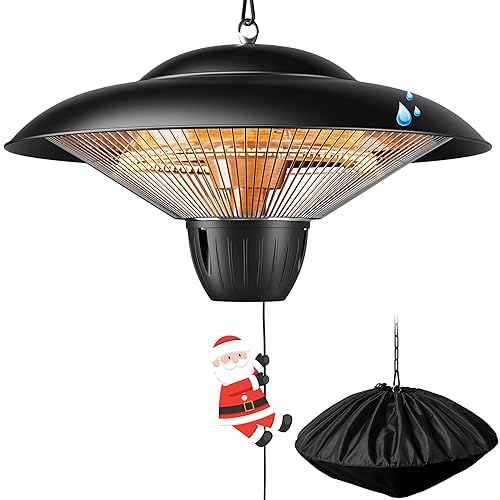
1500W Electric Infrared Wall/Ceiling Patio Heater
Best budget option.
The 1500W Electric Infrared Wall/Ceiling Patio Heater. It’s the most affordable unit in this comparison and performs closer to the mid-tier options than the price gap suggests.
Like the Paraheeter, it mounts to either wall or ceiling. The build quality is acceptable rather than excellent. The housing feels lighter than the Powerscale and the mounting bracket has less adjustment range. But if you’re equipping a secondary outdoor space, a garden shed porch, a garage side entrance, an outbuilding seating area, and you don’t need remote scheduling or app integration, the price difference over the Powerscale is real money and the heat output is the same.
The IP rating on this unit is IP55. The remote is basic but functional: power, high/low, and a timer function that tops out at 8 hours.
Pros.
- Lowest price in this roundup
- Wall or ceiling mount hardware included
- Timer function on remote
- 1500W output matches the pricier units
Cons.
- Lighter housing, less substantial feel
- Limited bracket adjustment range
- IP55 rating
,
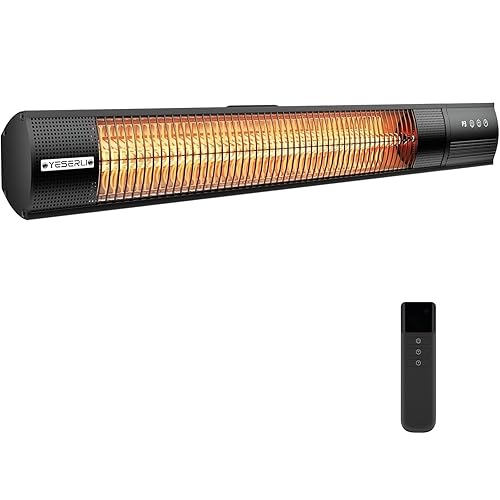
1500W Wall-Mounted Carbon Infrared Patio Heater with Remote
Best for targeted spot heat.
The 1500W Wall-Mounted Carbon Infrared Patio Heater with Remote is the one genuinely different option in this group, and it’s currently. Where the other four units use quartz infrared elements, this one uses carbon fiber heating elements.
Carbon infrared runs at a lower surface temperature than quartz but emits heat in a longer wavelength that penetrates deeper and distributes over a somewhat wider area. In practical terms, the heat feels less directional and more ambient. Whether that’s better depends on what you’re trying to heat. A single chair next to a mounted unit benefits from quartz’s focused output. A larger seating arrangement spread across 10 to 12 feet benefits from carbon’s wider distribution.

The unit comes with a remote and three power settings (500W, 1000W, 1500W). Build quality is solid, and the IP rating is IP55. If you’re mounting above a dining table on a covered patio, this is where I’d put my money. (I ran a carbon element unit from Infratech for a full outdoor season before switching to quartz for a different mounting location, so I’m working from comparison here rather than theoretical preference.)
Pros.
- Carbon infrared for wider heat distribution
- Three power settings add useful flexibility
- Good build quality
- Remote included
Cons.
- IP55 rating
- Carbon elements have a longer warmup time than quartz, around 90 seconds to full output
- Slightly higher price than the Powerscale
,
Buying Guide for Wall Mounted Patio Heaters
Infrared vs. Forced Air
Every unit in this roundup is infrared, and that’s the right call for outdoor use. Forced-air electric heaters warm the air, which disperses the moment wind moves through. Infrared heats surfaces and bodies directly. On a porch in October with any kind of breeze, that’s the distinction that determines whether a heater is actually useful.
Quartz vs. Carbon Elements
Quartz elements heat up fast (under 60 seconds), run hot, and deliver focused directional heat. They’re ideal for smaller spaces or when you want to warm a specific seating area from close range. Carbon elements take longer to reach full output but deliver a softer, more widely distributed warmth. If you’re choosing for a narrow covered porch where one person sits within 6 feet of the unit, quartz. If you’re choosing for a wider patio dining area, carbon is worth the premium.
Wattage and Electrical Requirements
All five units here are 1500W, which is the practical ceiling for a standard 120V, 15-amp household circuit (you’re drawing 12.5 amps, leaving modest headroom). If you’re running multiple heaters on one circuit, you’ll need an electrician involved. Single-unit installations are typically plug-and-play once you’ve run an outdoor-rated outlet to the mounting location.
The running cost at 1500W is approximately $0.18 to $0.22 per hour depending on your local rate (current national average is around $0.16 per kWh, but Connecticut and Northeast rates run higher). An evening’s use of three hours costs roughly $0.55 to $0.65 at the national average.

Mounting Height and Bracket Adjustment
Mount a wall-mounted heater too high and you’re projecting the heat over your guests’ heads. The practical sweet spot is 8 to 10 feet from the ground, with the bracket adjusted to direct heat downward at roughly a 30-degree angle. Check whether the bracket included with your unit allows tilt adjustment before you buy. The Powerscale and the carbon fiber unit both offer more adjustment range than the budget options.
IP Ratings
IP65 means protected against water jets from any direction. IP55 means protected against low-pressure water jets. For a unit mounted under an overhang, IP55 is sufficient. For a unit on an exposed wall where rain might blow sideways in a storm, IP65 is worth choosing. The Powerscale is the only IP65 unit in this group.
Propane as an Alternative
If you’ve been reading about propane fire pit burner options or a fire pit with hidden propane tank setup for your patio, propane can deliver more raw heat output than a 1500W electric unit. The tradeoff is fuel management, more involved installation, and the fact that open flame isn’t appropriate for every covered patio situation. Electric infrared is the better fit for enclosed or semi-enclosed outdoor spaces where you wouldn’t want a flame-based heat source. If your setup is more open and you want a social gathering centerpiece rather than background warmth, a fire pit table might do more for the space overall. We’ve covered the fire pit with coffee table format in depth if that’s worth comparing.
,
My Recommendation
The Powerscale 1500W is my top pick for most buyers. IP65 weatherproofing, a tilt-adjustable bracket, and a remote is a fair deal. If you’re equipping a wider covered dining area and want carbon infrared distribution, the carbon fiber unit is the better call. And if you’re working with a tighter budget on a secondary space, the budget infrared option delivers the same 1500W output for less.
The full range of heat and fire options for outdoor spaces is covered over in our outdoor fire and heat guide if you’re still deciding whether a wall-mounted heater is the right format for your setup.
,
Frequently Asked Questions
How much does it cost to run a 1500W wall mounted patio heater?
At the current national average electricity rate of around $0.16 per kWh, a 1500W heater costs roughly $0.24 per hour to run. Three hours of use per evening runs about $0.72. If you’re in the Northeast where rates are higher, closer to $0.25 to $0.30 per kWh, budget around $1.00 to $1.35 for the same session. None of these numbers should be alarming if the heater is actually extending the time you spend outside.

Can I install a wall mounted patio heater myself?
Yes, for most homeowners. The mounting process is a standard wall anchor job with a drill and stud finder. The electrical side assumes you already have an outdoor-rated outlet at or near the mounting location. If you don’t have one, that part requires a licensed electrician. Don’t run an extension cord to a permanent installation.
What’s the difference between IP55 and IP65 on outdoor heaters?
Both ratings indicate the unit can handle rain. IP55 means it’s protected against low-pressure water jets from any direction. IP65 adds protection against sustained, higher-pressure water contact. For a heater mounted under a porch roof, IP55 is adequate. For an exposed wall installation where driving rain might hit the unit directly, IP65 is worth prioritizing. The Powerscale is the only IP65-rated unit in this roundup.
How high should I mount a wall mounted patio heater?
Between 8 and 10 feet is the standard guidance, with the bracket adjusted to direct heat downward at roughly a 30-degree angle. At less than 8 feet, you risk the unit being uncomfortably close to standing guests. Much above 10 feet and the heat disperses before reaching seating level. If your mounting wall is unusually tall, look for a unit with wide bracket tilt adjustment rather than one that only mounts parallel to the wall.
Is a wall mounted electric heater better than propane for a covered patio?
For covered or semi-enclosed spaces, electric infrared is the safer and more practical choice. Propane combustion produces carbon monoxide and water vapor, which aren’t concerns in fully open air but become problems with limited ventilation. Electric units also have no open flame, which matters under wood pergolas, canvas structures, or anywhere with low clearance. Propane delivers more raw heat output and has its place in open outdoor setups. For covered patios specifically, electric is the right call.
Powerscale 1500W Electric Wall-Mounted Patio Heater
- Wall-mounted saves floor space
- Electric , no gas lines needed
- Requires wall mounting installation
Paraheeter Electric Infrared Patio Heater
- Wall-mounted saves floor space
- Electric , no gas lines needed
- Requires wall mounting installation
WiFi Wall-Mounted Electric Outdoor Heater, 1500W
- Wall-mounted saves floor space
- Electric , no gas lines needed
- Requires wall mounting installation
1500W Electric Infrared Wall/Ceiling Patio Heater
- Wall-mounted saves floor space
- Electric , no gas lines needed
- Requires wall mounting installation
1500W Wall-Mounted Carbon Infrared Patio Heater with Remote
- Wall-mounted saves floor space
- Electric , no gas lines needed
- Requires wall mounting installation
Frequently Asked Questions
Are electric wall-mounted patio heaters as effective as propane patio heaters?
Electric infrared wall heaters deliver heat comparably to propane for covered patios and pergolas, but with faster startup (typically under 30 seconds) and no fuel logistics. Propane still wins in open or windy spaces where the radiant warmth from infrared can dissipate before reaching occupants, but for enclosed or semi-enclosed patios, electric is often the better practical choice.
What wattage do I need in a wall-mounted electric patio heater?
For a small covered patio up to about 100 square feet, a 1,500-watt unit is typically sufficient. Larger patios of 150 to 300 square feet generally need 2,000 to 3,000 watts or multiple units positioned for even coverage — ambient temperature and how exposed the space is to wind significantly affect the sizing calculation.
Can a wall-mounted patio heater be used under a covered porch or pergola?
Yes — wall-mounted electric infrared heaters are specifically designed for covered outdoor spaces where they can reflect radiant heat downward without exposure to direct rain. Most models carry an IP65 or IP55 weatherproof rating suitable for sheltered outdoor use; check the rating before installing in any space where the heater could contact moisture.
How difficult is it to install a wall-mounted patio heater?
Most electric wall-mounted patio heaters mount similarly to a large light fixture — a bracket attaches to the wall with screws, and the unit plugs into a standard 120V or 240V outdoor outlet. Units requiring a 240V circuit need a dedicated outlet installed by an electrician if one is not already present near your intended mounting location.
Do wall-mounted patio heaters work in cold climates, or only in mild weather?
Infrared wall heaters work by warming objects and people directly rather than heating the air, so they remain effective in cold temperatures as long as occupants are within the radiant field. In very cold climates (below 20°F), most units become supplemental rather than primary heat sources, and a higher-wattage model or multiple units will be needed to maintain comfort.
Where to Buy
Powerscale 1500W Electric Wall-Mounted Patio HeaterSee Powerscale 1500W Electric Wall-Mounte… on Amazon